Some people jump right in and hike the PCT without training, but we plan to start the trail in good walking shape. So far most of our training has consisted of traipsing around San Francisco. Chris has begun carrying heavy photography books in his backpack on his daily walking commute. But our most enjoyable form of training is going on local hikes with friends and family. Here are some of our favorites from the past few months.
Good maps are essential. We plan to use two types of maps on our thru-hike, plus a third map type to keep folks at home informed about our location.
Paper maps
As a public service, a hiker named Half Mile has created a wonderfully detailed set of topo maps covering the entire Pacific Crest Trail. The maps include terrain, notes, and points of interest like campsites, post offices, and water sources. The route of the PCT is well-marked on the maps, as are side trails. Elevation profiles are placed at the end of each section. Check out Half Mile’s website to download free PDF files of the maps. We had the maps printed double-sided (less paper to carry) on a color laser printer (they won’t smear if wet). We’ll send ourselves the appropriate map sections in our food boxes, so we won’t have to carry them all at once.
A Half Mile map page with notes
Even if you have a GPS, it’s important to carry a paper map and compass as a backup. The GPS might fail, and it can lose its view of the sky in steep canyons or dense forests. If you don’t know how to read a topo map or take a bearing with a compass, orienteering is a fun way to learn!
The “big three” in backpacking refers to your heaviest pieces of gear — tent, sleep system, and backpack. The best gear varies for each person’s needs because there are tradeoffs between weight, comfort, and price. Below we explain how we selected our big three items.
Tent
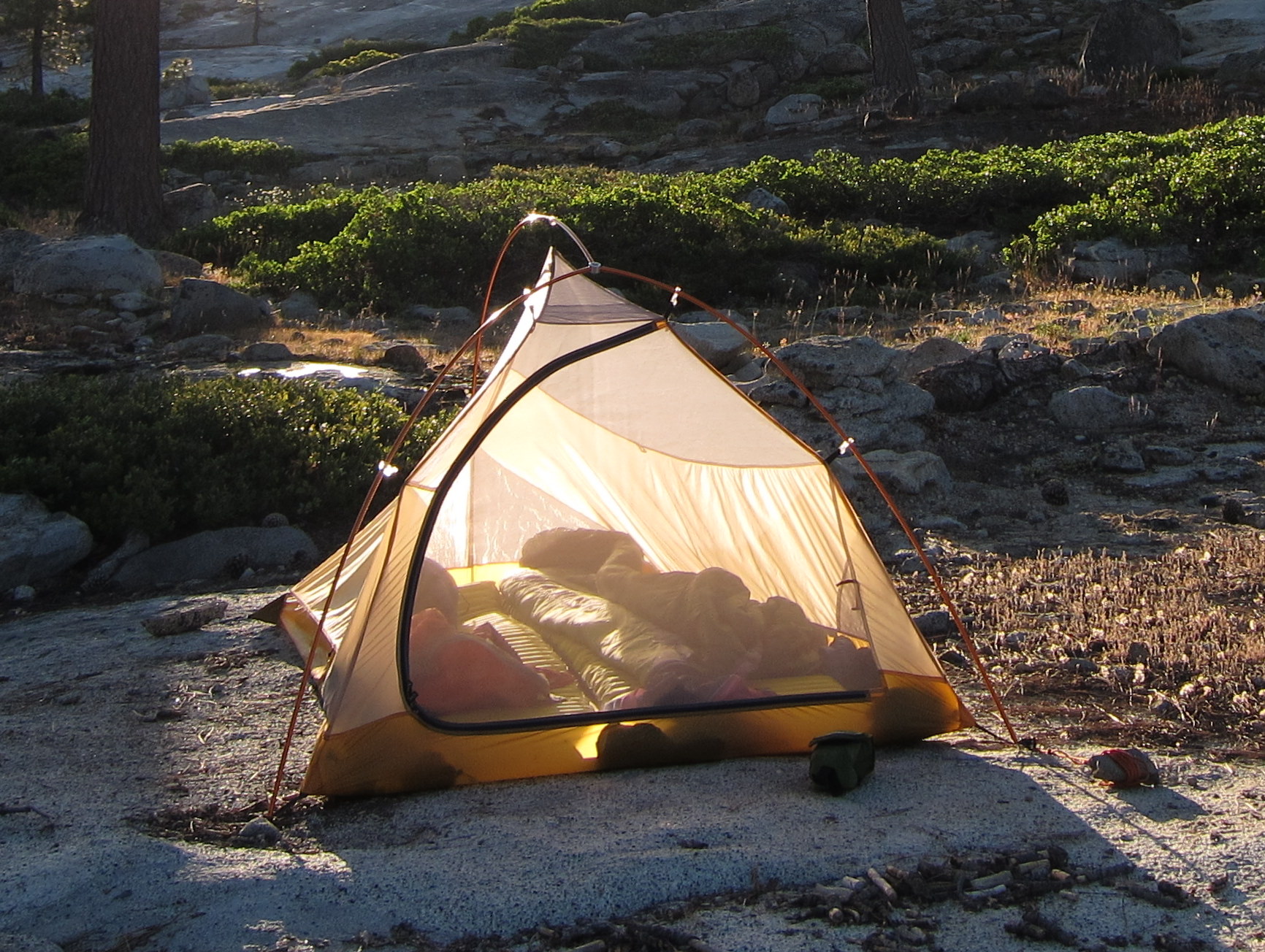
Big Agnes Fly Creek UL2 (without rain fly)
We love our Big Agnes Fly Creek UL2. It suits our weight/comfort/price mix perfectly. After removing extra stuff sacks, and replacing the stakes with 6 Vargo Titanium Ultralight hooks, this 2-person tent weighs only 2.3 pounds! This is very light, and as you can imagine, when trekking such a long way we opt for less weight on our backs whenever possible. It’s cozier than most tents, but two sleeping pads fit perfectly next to one another inside and we’d rather have the lighter weight than extra space. This is a free standing tent, which is more convenient than a tent in which you must use your trekking poles as supports.


 Wandering the Wild